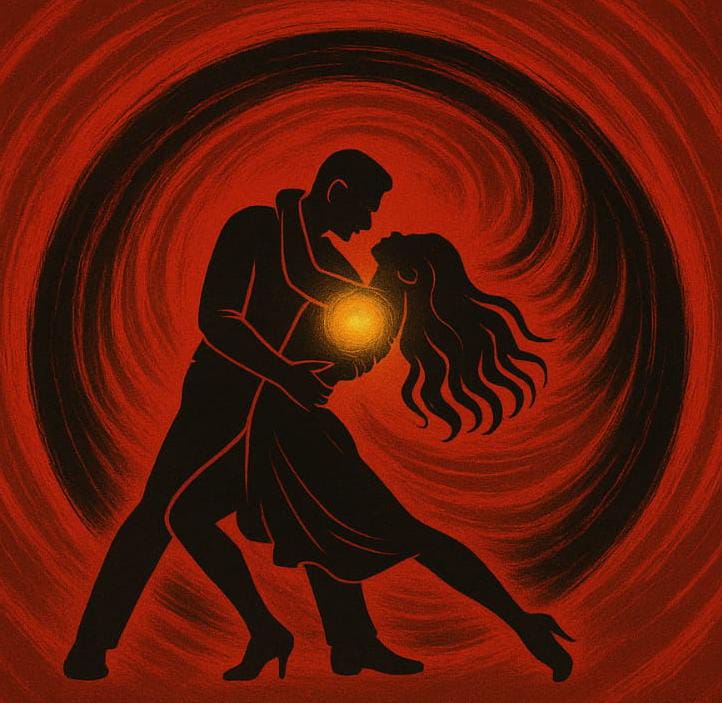
Fusion Partner Dancing: What Happens When Tango Meets Salsa and Bachata
An honest exploration of how Argentine tango vocabulary breathes new life into Latin rhythms — and what we've learned from years of experimenting at TaoTango.
Fusion partner dancing is dancing Argentine tango vocabulary on salsa and bachata music. At TaoTango, we've been experimenting with this practice in our regular classes on beaches in Arambol, in mountain studios in Dharamkot, and in rooftop spaces in Rishikesh.
What is Fusion Partner Dancing?
Fusion partner dancing is not about dancing badly to the wrong music. It is the intentional practice of bringing the vocabulary, aesthetics, and philosophy of one dance form into dialogue with the music — or body language — of another.
The partner dancing world has seen several defined fusions emerge over recent decades:
- Lindy Tango — swing vocabulary meeting tango musicality
- Blues Tango — the grounded sensuality of blues merged with tango's embrace
- Kizomba Tango — the Angolan walk meeting the Argentine walk
- Tango Nuevo — tango opening itself up to jazz and electronic music
Tango vocabulary works particularly well on salsa and bachata music, which are the dominant rhythms in Latin America. Salsa and bachata dancers often have rhythm skills and body awareness that translates well to tango practice.
The Salsa Experiment
Salsa has a clave pattern (2-3 or 3-2), cascading congas, and bright brass. When dancing tango on salsa music, tango's relationship to the beat changes. In traditional tango, you hunt for the strong beat. In salsa, the rhythm is layered and cyclical. Tango dancers find that instead of following every beat, they find the phrase. A pausa that normally lasts one count becomes longer, spanning multiple salsa counts.
What We Actually Do in Class
We begin with closed embrace tango, then switch the music to salsa without warning. The instruction is simple: keep your tango body. Keep your axis. Keep your connection. Let the salsa rhythm suggest — but don't obey it blindly. Find the conversation between what you know and what you're hearing. The results are always revelatory.
Tango Moves That Translate Beautifully to Salsa
- The ocho cortado — a quick, rhythmic cut that fires perfectly on salsa's syncopated breaks
- Sacadas — the displaced steps that create surprising spatial dynamics between partners
- Walking in cross system — creates counter-rhythm against the salsa beat that feels thrillingly off-balance in the best way
- The led back ocho — becomes a sensual swirl across multiple phrases
- Pausing mid-combination — perhaps the most radical tango gift to salsa: knowing when to stop
The Bachata Experiment
Bachata originated in the Dominican Republic. In traditional bachata, the walk is simple — 1, 2, 3, tap, 5, 6, 7, tap. Tango and bachata dancers both practice with slow, intimate music. When you dance tango vocabulary on bachata music, the two styles work naturally together.
The Walk
The tango walk (caminata) doesn't step to a count — it moves with the musical phrase. When dancing the tango walk on bachata music (especially bachata sensual), dancers get clear feedback on their timing. Students report this helps them understand what "walking with presence" means.
The Embrace
Bachata sensual uses a close embrace similar to tango. In our classes, we place dancers in tango's abrazo — chest to chest, weighted and grounded — then let bachata's undulating rhythms suggest movement through body waves, lateral sways, and circular weight shifts. This combination of tango structure with bachata rhythm works well for developing partner connection.
What We Actually Do in Class
We teach a sequence of tango combinations, then play bachata and ask dancers to find three places in the phrase where they would naturally pause in tango — and to use those pauses as connection moments rather than movement moments. The instruction: listen to your partner's breath, not the beat. This exercise has produced some of the most profound partner-connection breakthroughs we've seen in any style of dance.
What Salsa and Bachata Give Back to Tango
The exchange isn't one-directional. Our fusion experiments have consistently revealed things about tango itself that years of dancing only to tango music had obscured:
- Joy. Traditional tango carries a weight of seriousness — appropriate to its origins, but sometimes limiting. Salsa's exuberant rhythms invite tango dancers to rediscover lightness and play within the same technique.
- Rhythm literacy. Tango dancers trained only on tango music often struggle with complex poly-rhythmic landscapes. Bachata and salsa develop a richer rhythmic ear that, when brought back to tango, produces dancers who can interpret Piazzolla and Pugliese with far greater sophistication.
- Body freedom. The hip movement of salsa and the body wave of bachata sensual introduce physical vocabulary that tango technique traditionally suppresses. Incorporating this — even subtly — loosens bodies that have become too rigid in their tango correctness.
- The courage to improvise. When the music is unfamiliar, you can't fall back on choreographed patterns. Fusion forces genuine improvisation, which is, after all, what tango demands at its highest level.
How We Experiment in Class: Meeting Students Where They Are
Fusion experiments aren't confined to specialized sessions. They're woven directly into our regular classes, tailored to the diverse backgrounds of our students. On any given evening at TaoTango, you might find tango dancers learning to move with salsa's joy, salsa dancers discovering tango's depth, or completely new students experiencing the conversation between all three languages for the first time.
When Tango Dancers Join Us
For experienced tango dancers, we often begin the evening with traditional tango, then surprise them partway through by switching the playlist. We might shift to salsa or bachata without warning and give one simple instruction: "Everything you've learned is still available to you. What happens when you choose to use it differently?"
The breakthroughs happen quickly. Dancers who've spent years mastering Argentine technique discover they never truly owned their own movement — they were being carried by the familiar music. When that structure is removed, they find something they didn't know they were looking for: agency. Freedom within knowledge. The ability to translate their understanding rather than simply execute a learned pattern.
When Salsa or Bachata Dancers Join Us
Students arriving with a salsa or bachata background have an entirely different gift to bring and a different challenge to meet. They know rhythm. They understand hip movement and spatial awareness. But they often haven't experienced the depth of connection and slowness that Argentine tango demands.
In our classes, we might teach a sequence in a salsa rhythm, then ask them to "make it tango" by slowing down, deepening the embrace, and finding presence instead of movement. The result is often revelation. A student who thought they knew their body through years of salsa suddenly feels how much nuance they've never explored. They experience what it means to listen to a partner's breath rather than follow the beat.
When Beginners or Mixed Groups Join Us
For students new to partner dancing or mixed groups with multiple backgrounds, fusion becomes the gateway rather than the destination. We don't start with "here's tango, here's salsa, here's bachata." We start with a simple question: "What happens when two people listen to each other?"
We teach basic vocabulary — a simple walking pattern, the concept of embrace, basic turns — then play different music and ask: "Can you dance this same movement to different rhythms? What changes? What stays constant?" Beginners discover that the core principle is listening, not style. This demystifies all the different dances and allows them to approach new styles with curiosity rather than intimidation.
Real Class Example
We start with a 10-minute tango lesson, building a simple combination: walk, pause, back ocho, resolution. Dancers practice with tango music, getting comfortable. Then: "New music." We switch to bachata. Same combination. The rhythm doesn't match. Bodies hesitate. But then something shifts — dancers realize the combination still makes sense, it just feels different. We do it again with salsa. By the third time, dancers aren't thinking about steps anymore. They're thinking about connection, about listening, about why the same movement lives differently in different musical worlds.
Why We Experiment
Our community includes dancers from many traditions — tango specialists, salsa dancers, bachata dancers, complete beginners, and people who've danced multiple styles. When a tango dancer partners with someone whose primary experience is salsa, both dancers expand their skills. The tango dancer develops better rhythm awareness. The salsa dancer learns tango's emphasis on connection and presence.
How to Begin Your Own Fusion Journey
You don't need to be an advanced dancer to explore fusion. Here are practical starting points, whether you're coming from tango, salsa, or bachata:
If you primarily dance tango:
- Put on a bachata song and simply walk — your tango walk — to the rhythm. Don't step on every count. Find the phrases.
- Play salsa and practice only pausing. Let the music run. Step once every eight counts. Notice how your partner responds.
- Try leading or following a single back ocho across an entire bachata verse. Slow everything down beyond what feels comfortable.
If you primarily dance salsa or bachata:
- Try closing your eyes and taking a tango embrace with your partner. Then simply breathe together until you feel each other's weight. That's your foundation.
- Play one of your familiar salsa songs and try to step only when you feel moved to — not when the rhythm demands it. Discover what's left when you remove the obligation to match every beat.
- Take a tango class. Seriously. Even one class will permanently change how you listen to salsa music — because suddenly you'll hear the phrases and not just the beats.
Join Our Classes
Fusion experiments happen naturally in our regular classes. Every evening, you'll meet dancers from different backgrounds — and that diversity is where the real magic unfolds. Whether you're a tango dancer, a salsa dancer, or completely new to partner dancing, you'll find a community ready to listen.
View Classes WhatsApp Us